
Guide
How to plan a road trip, step by step
8 steps · how far to drive a day · what to book first · checklist
A good road trip is mostly decided before you leave: how far you drive each day and where you sleep. Get those two right and everything else — the detours, the lunch stops, the view you didn't plan for — fits around them. Here's the method, in the order that actually works.
To plan a road trip: (1) choose the shape — one-way, loop, or a base with day trips; (2) set a daily driving limit, about 4–5 hours; (3) place your overnight stops at that spacing; (4) fill in the stops between; (5) check the season and road closures; (6) book the hardest nights first; (7) budget the whole trip, not just fuel; (8) prep the car and paperwork.
The eight steps
- 1
Choose the shape of the trip
A one-way drive (A to B) covers the most ground but usually means a one-way car-rental fee, which can be steep across a border. A loop brings you back to where you started — no drop fee, and the return leg can take a different road. A base with day trips (two or three bases, several nights each) means less packing and more seeing; it suits families and regions dense with sights.
- 2
Set a daily driving limit
Four to five hours behind the wheel is a comfortable day — roughly 300–400 km (200–250 miles) on motorways, much less on mountain or coastal roads. Add a quarter on top for fuel, food and photo stops, and plan a break at least every two hours. Six hours is a long day; eight is a transfer, not a holiday.
- 3
Place your overnight stops
Divide the route at your daily limit and look for towns near the cut points. One night is for getting through; two nights or more is for actually seeing a place, because only then do you get a full day there. Avoid strings of one-nighters — three in a row is where road trips turn into chores.
- 4
Fill in the stops between
Now add what you stop for: viewpoints, a lunch town, a short hike, a detour worth 30 minutes. These are pass-through stops — no bed, just time — so keep an eye on how they stretch the day. Every stop costs more time than the drive to it.
- 5
Check the season and the roads
Dates change everything: high-mountain passes in the Alps and many scenic roads in North America's national parks close for months each winter, peak season can double room prices, and daylight decides how much driving is pleasant. Check opening dates for any pass, ferry or park road on the route.
- 6
Book the hardest nights first
Book where beds are scarce before where they're plentiful: small towns, national-park lodges, islands, festival dates and anything in peak season. Cities can wait. Keep the flexible nights on free-cancellation rates so you can still move a stop.
- 7
Budget the whole trip
Fuel is rarely the big number. Price stays per night, food per person per day, activities, parking, tolls and motorway vignettes, ferries, and the rental — including any one-way fee. Then find the one stop or one night that makes it expensive and decide if it's worth it.
- 8
Prep the car and the paperwork
Licence (and an International Driving Permit if a country on the route requires one), insurance that covers every country you cross, vignettes bought before the border, offline maps downloaded, a paper or PDF copy of the plan with booking numbers, and — for an EV — fast chargers checked on the long legs.
Doing it in Stopful
Every step above works with a notebook and a map. If you'd rather have the arithmetic done for you, this is how each one maps onto Stopful — free, no account:
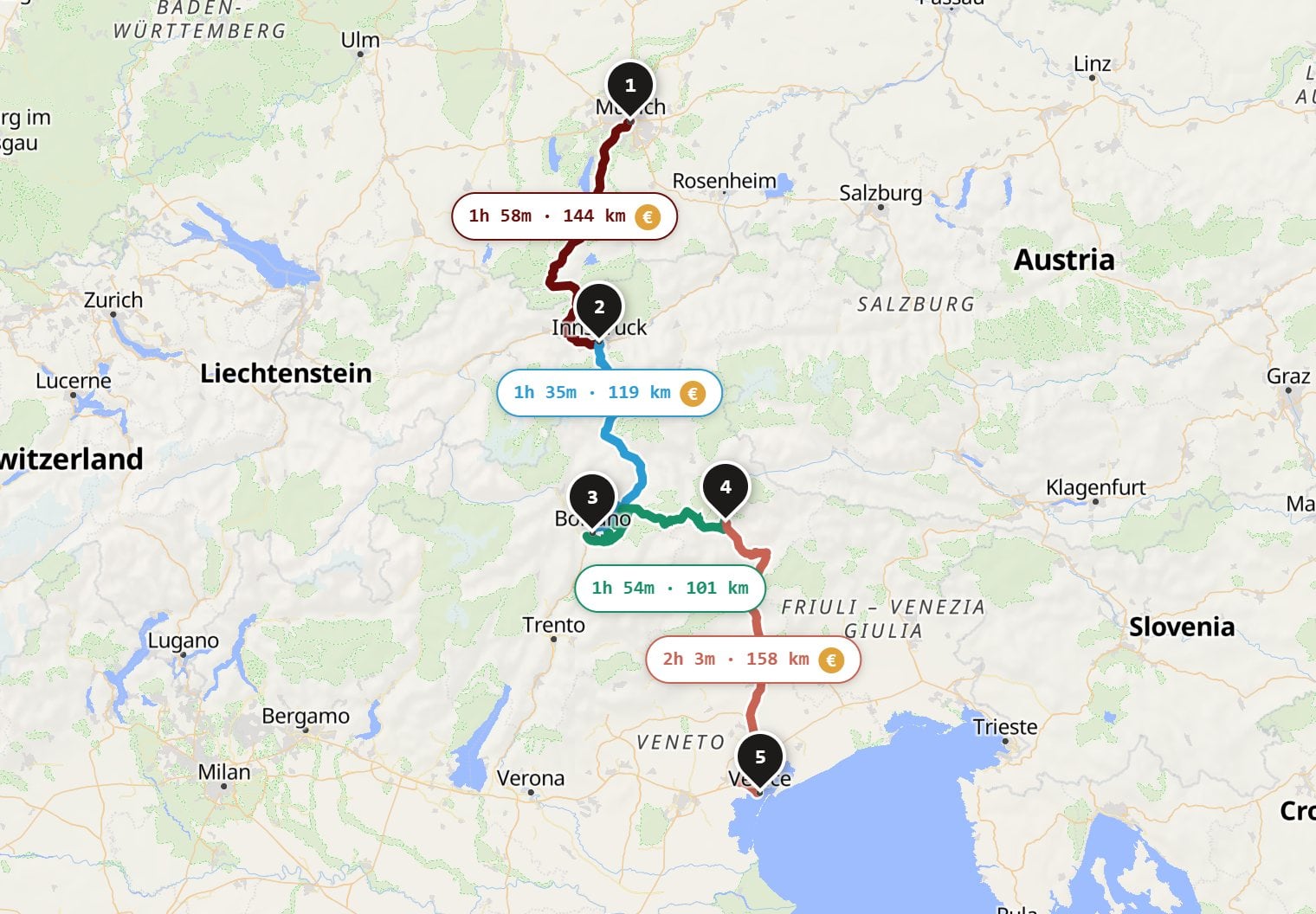
Free · no sign-up · no ads — or start from a ready-made route
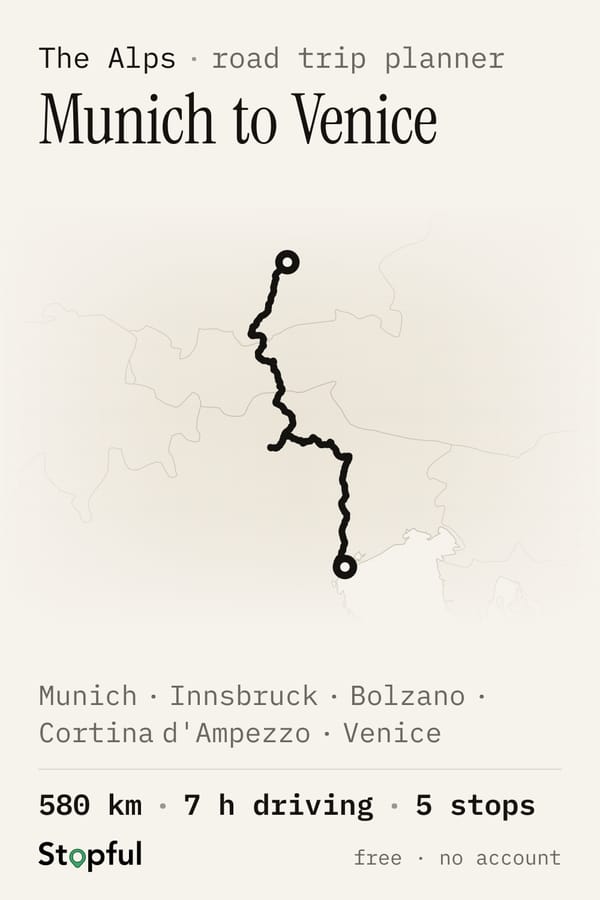
Or start from a ready-made route
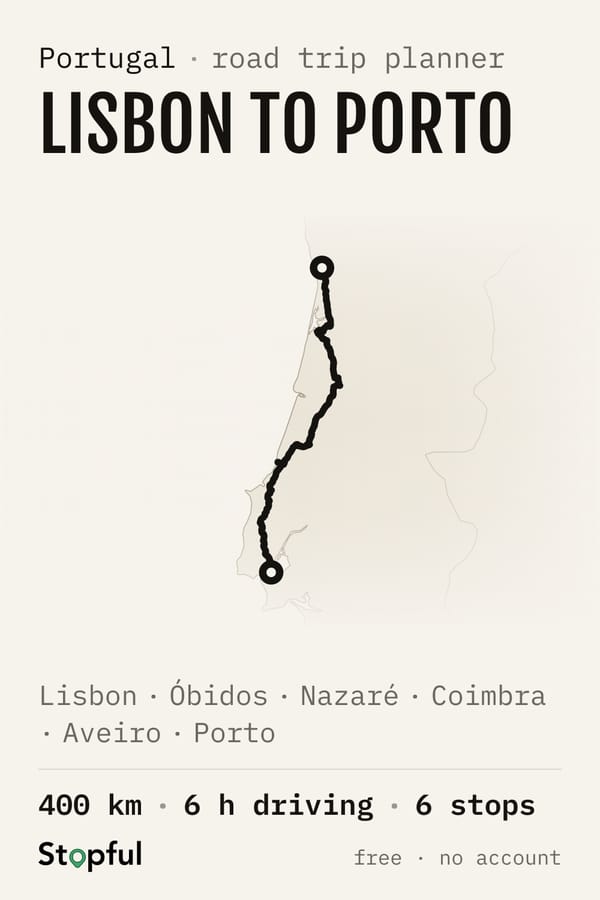
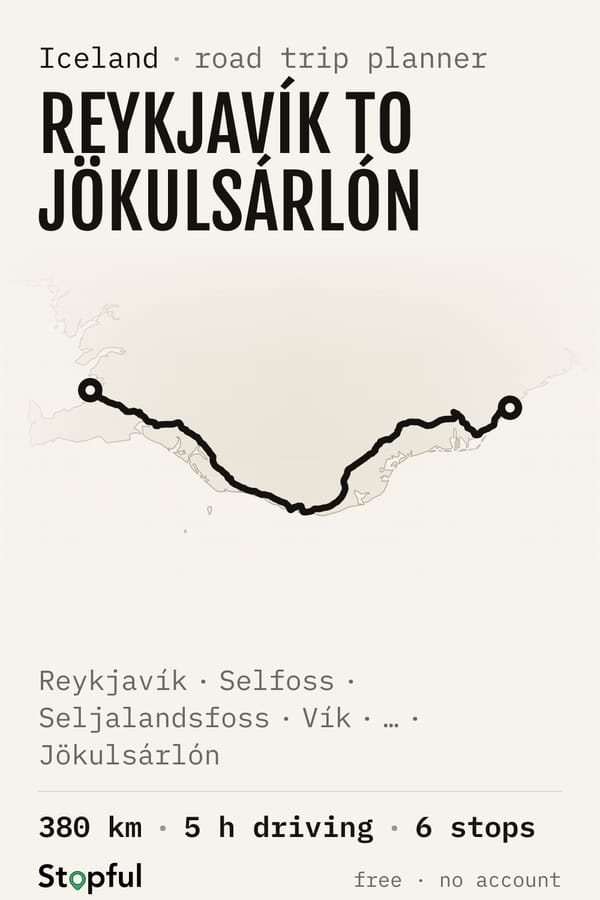
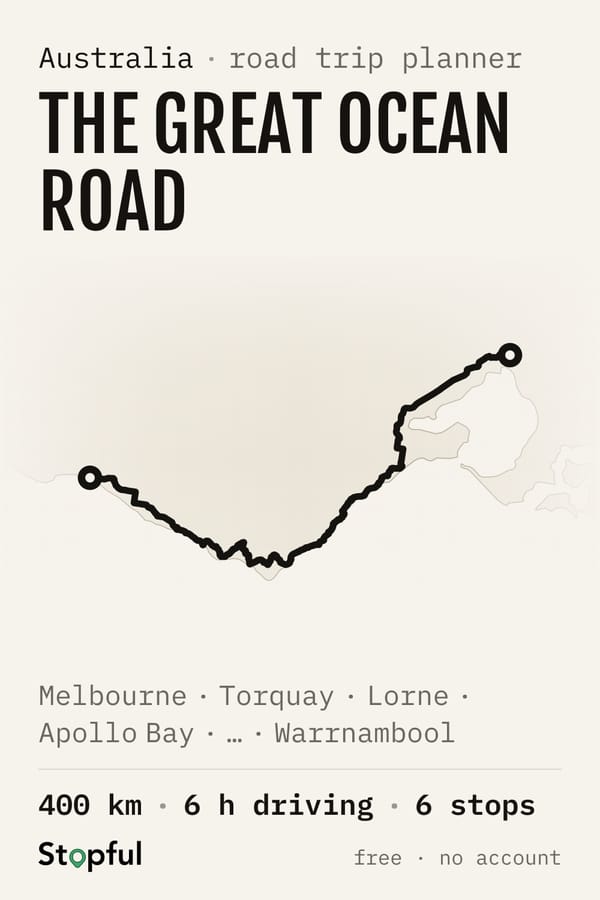
How far should you drive in a day?
The short answer: 4–5 hours of driving, which is 300–400 km (200–250 miles) on motorways. The road matters more than the distance — a mountain or coastal road can halve your average speed, and a city at either end adds an hour you won't see on the map.
| Driving per day | Roughly | What it feels like |
|---|---|---|
| 2–3 hours | 150–250 km · 100–150 mi | Relaxed — time for a long lunch and a detour. Best with kids. |
| 4–5 hours | 300–400 km · 200–250 mi | The sweet spot for most road trips. |
| 6–7 hours | 450–600 km · 280–370 mi | A long day. Fine once or twice, tiring in a row. |
| 8+ hours | 650 km+ · 400 mi+ | A transfer day — you'll see the road, not the places. |
Whatever your number, stop at least every two hours (the UK Highway Code recommends a 15-minute break every two hours), and share the driving if you can.
How to plan a road trip with multiple stops
Separate the two kinds of stop, because they behave differently. Overnight stops set the skeleton — they decide where each day ends and what you have to book. Pass-through stops (viewpoints, lunch, a quick walk) hang off that skeleton and only cost time. Place the overnights first at your daily-limit spacing, then add pass-through stops and check that no day has swollen past your limit — it's the pass-through stops that quietly turn a four-hour day into seven.
Keep the stops in driving order and avoid doubling back; if a sight forces a backtrack, it's often better as a day trip from the nearest overnight stop.
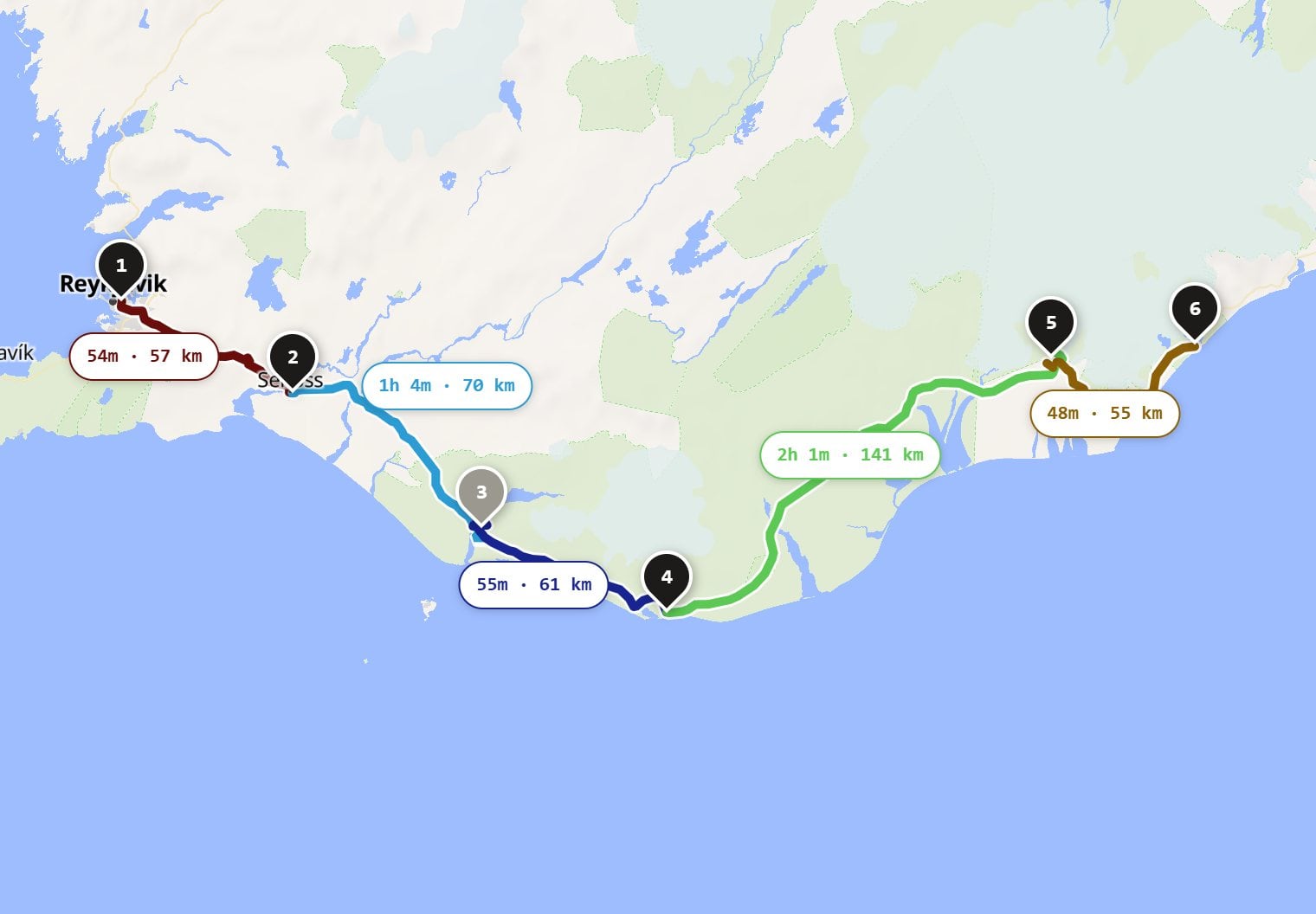
Planning a road trip on Google Maps — and where it runs out
Google Maps is excellent for driving a route: live traffic, turn-by-turn, and you can add several stops to one set of directions. It's weaker at planning one — a single route only takes a handful of stops (ten places at most), and it has no idea of nights, days, bookings or budget. Google My Maps lets you pin and layer places, but its directions are limited per layer and it doesn't split anything into days.
The usual combination: plan the trip — stops, nights, days, where to sleep, what it costs — in a road-trip planner, then open each day's leg in Google Maps to drive it. Stopful has a Directions in Google Maps button on every leg for exactly that. More detail in Stopful vs Google My Maps.
Planning a road trip in an electric car
An EV changes step 3: you place overnights where you can charge, not just where you want to sleep. Plan the legs with fast chargers (DC, 50 kW and up) in view, prefer hotels with destination charging, and leave slack on long legs — cold weather, speed and elevation all cut range. For state-of-charge planning on tight legs, a range specialist like A Better Route Planner is worth pairing with your trip plan. See how to plan an EV road trip.
Using AI to plan a road trip
ChatGPT and Claude are good at the first draft — which towns, how many nights, what to see — and bad at the geography: an AI itinerary often looks fine as text and turns out to be eight hours of driving on day three. The fix is to put the draft on a map before you trust it. Stopful connects to ChatGPT and Claude: the assistant plans, the trip appears on an editable map in the chat with real drive times, and you adjust from there. A prompt that works well:
“Plan a 7-day road trip from Lisbon to Seville for two, max 4 hours of driving a day, two nights in at least two places, and plot it on a map with Stopful.”
More prompts, and what AI tends to get wrong, in how to plan a road trip with AI.
Road trip planning checklist

Weeks before
- Route shape chosen; one-way rental fee checked
- Daily driving limit set; overnight stops placed
- Scarce nights booked (small towns, parks, islands, peak dates)
- Pass, ferry and park-road opening dates checked
- Budget: stays, food, fuel or charging, tolls, vignettes, parking, activities
- International Driving Permit, if a country on the route requires one
The week before
- Insurance covers every country on the route; breakdown cover sorted
- Vignettes bought for countries that need them (e.g. Switzerland, Austria, Czechia, Slovenia, Hungary, Romania)
- Offline maps downloaded for every region
- Itinerary printed or saved as PDF, with booking confirmation numbers
- Car checked: tyres, fluids, spare or repair kit, phone mount and charger
On the road
- A break every two hours; swap drivers
- Refuel or charge before it's urgent on remote stretches
- Re-check tomorrow's leg each evening — roadworks and closures change
Road trip planning — FAQ
- How do I plan a road trip?
- Choose the shape of the trip (one-way, loop, or a base with day trips), set a daily driving limit of about 4–5 hours, place your overnight stops at that spacing, fill in the stops between, check the season and road closures, book the hardest nights first, budget the whole trip, and prep the car and paperwork.
- How many hours a day should you drive on a road trip?
- About 4–5 hours of driving is comfortable for most people — roughly 300–400 km (200–250 miles) on motorways, less on mountain or coastal roads. Take a break at least every two hours. Six or more hours is a long day; plan those sparingly.
- How many nights should I stay at each stop?
- One night is for getting through; two or more is for seeing a place, because that's the only way to get a full day there. Avoid more than two one-night stops in a row.
- How far in advance should I plan a road trip?
- For a peak-season trip, start a few months ahead and book the scarce nights — small towns, national-park lodges, islands — first. Off-season and city stops can usually be booked a few weeks out.
- Can I plan a road trip with multiple stops on Google Maps?
- You can add several stops to one set of Google Maps directions (up to ten places), which is great for driving a day's route. It doesn't handle nights, days, bookings or budget, so most people plan the trip in a road-trip planner and use Google Maps to navigate each leg.
- What is the best free road trip planner?
- It depends on the trip. Stopful is free with no account and plans stops, nights, drive times, hotels, EV chargers and a budget on one map. Roadtrippers is strong for US attractions, Wanderlog for live group planning, and A Better Route Planner for EV range. The comparison at stopful.com/compare lays out the differences honestly.
- How much does a road trip cost?
- Mostly stays and food, not fuel. Price nights per room, food per person per day, activities, fuel or charging, tolls and vignettes, parking and the rental (including one-way fees). Stopful's road trip cost calculator publishes worked figures for 22 destinations and 37 routes.
Keep going
- 37 ready-made road trips, every stop mapped
- Road trip cost calculator
- Print your road trip itinerary
- Plan a road trip with friends
- Road trip planners compared
- Plan a road trip with AI (ChatGPT, Claude)
- Make a road trip map (and download it as an image)
- Free road trip itinerary template (spreadsheet + printable)